

You make a positive impact on the environment when you choose eco-friendly paper packaging solutions. Many customers now expect sustainable options. Recent trends show that over 70% of online shoppers prefer brands that use eco-friendly packaging. This shift not only helps the planet but also strengthens your brand. The table below highlights how these choices affect consumer behavior:
|
Statistic |
Description |
|---|---|
|
73% |
Consumers actively looking to reduce their environmental impact. |
|
41% |
Buyers willing to pay more for eco-friendly products with sustainable packaging. |
Exploring new and surprising options can set your business apart and meet these expectations.
Key Takeaways
- Choosing eco-friendly paper packaging can enhance your brand image and meet customer expectations for sustainability.
- Look for certifications like FSC and PEFC to ensure your packaging meets environmental standards and builds consumer trust.
- Prioritize packaging that is both recyclable and compostable to minimize waste and support eco-friendly practices.
- Engage customers with innovative packaging solutions, such as seed-infused paper, which promotes sustainability and enhances brand loyalty.
- Test your packaging in real-world conditions to ensure durability and effectiveness, reducing waste and improving customer satisfaction.
Sustainable paper packaging solutions
Eco-friendly materials and sourcing
You can make a big difference by choosing eco-friendly materials for your packaging. These materials help you reduce your environmental footprint and show your commitment to sustainability. Many businesses now use sustainable packaging materials to meet customer expectations and support the planet.
- Recycled paper and cardboard lower the need for new resources. This choice helps cut down on deforestation and saves energy.
- Biodegradable plastics break down over time. They do not stay in the environment for years.
- Plant-based plastics, also called bioplastics, come from renewable resources. You can compost them, which keeps waste out of landfills.
- Compostable materials turn into natural elements without leaving harmful residues.
- Molded fiber uses recycled paper pulp. It is biodegradable and offers a sustainable alternative to polystyrene foam.
You can source sustainable packaging from many regions. North America leads the market, by Europe and Asia-Pacific. The table below shows the main regions and countries that focus on sustainable packaging materials:
|
Region |
Market Share |
Leading Countries |
|---|---|---|
|
North America |
40% |
United States, Canada |
|
Europe |
30% |
Germany, France, United Kingdom |
|
Asia-Pacific |
25% |
China, Japan, India |
By choosing suppliers from these regions, you support global sustainability efforts and ensure your packaging meets high standards.
Certifications and standards for sustainability
You should look for certifications when selecting sustainable packaging solutions. These certifications prove that your packaging meets strict environmental and social standards. They also build trust with your customers and partners.
|
Certification |
Overview |
Environmental Impact |
Business Benefits |
|---|---|---|---|
|
FSC |
Guarantees responsible forest management |
Reduces deforestation and maintains carbon sequestration |
Higher consumer trust and easier market access |
|
PEFC |
Regional certification for sustainable forest management |
Ensures long-term sustainability of forest resources |
Bolsters CSR profiles and improves supply chain transparency |
|
ISO 14001 |
Standard for environmental management |
Reduces emissions and environmental degradation |
Reduces operating costs and strengthens brand reputation |
|
RSPO |
Ensures sustainable palm oil sourcing |
Reduces deforestation and habitat destruction |
Improves supply chain transparency and credibility |
|
Bonsucro |
Promotes sustainable practices in sugarcane |
Lowers water usage and greenhouse gas emissions |
Enhances marketing appeal and consumer trust |
The Forest Stewardship Council (FSC) sets rules for responsible forest management. This certification ensures that your paper packaging comes from sustainable sources. It also covers social issues, such as fair labor and the rights of local communities. The Programme for the Endorsement of Forest Certification (PEFC) also supports sustainable practices and boosts your brand’s credibility.
You can trust these certifications to cover important areas like water quality, forest cover, and wildlife protection. They help you avoid hazardous chemicals and protect old forests. By choosing certified packaging, you show your dedication to sustainability and eco-friendly packaging.
Recyclability and compostability of paper packaging
You should always check the recyclability and compostability of your packaging. These features help you lower your environmental impact and meet the growing demand for sustainable packaging solutions.
|
Type of Packaging |
Environmental Impact |
Key Benefits |
|---|---|---|
|
Compostable |
Breaks down into natural elements without toxic residues. |
Returns nutrients to the soil, reduces landfill waste, and is suitable for food packaging. |
|
Recyclable |
Can be processed and reused, conserving natural resources. |
Generates 74% less air pollution and uses 50% less water compared to virgin paper production. |
Compostable packaging breaks down into natural elements. It does not leave toxins behind and returns nutrients to the soil. This type of packaging works well for food products and helps you reduce landfill waste. Recyclable packaging can be processed and used again. Recycling saves resources and cuts down on pollution. In fact, recycling paper creates 74% less air pollution and uses 50% less water than making new paper.
You should always label your packaging clearly. This helps customers recycle or compost it the right way. By focusing on recyclability and compostability, you support sustainability and show your commitment to eco-friendly packaging.
Tip: Choose packaging that is both recyclable and compostable when possible. This gives you the best results for sustainability and customer satisfaction.
How to choose eco-friendly packaging solutions
Balancing cost, durability, and sustainability
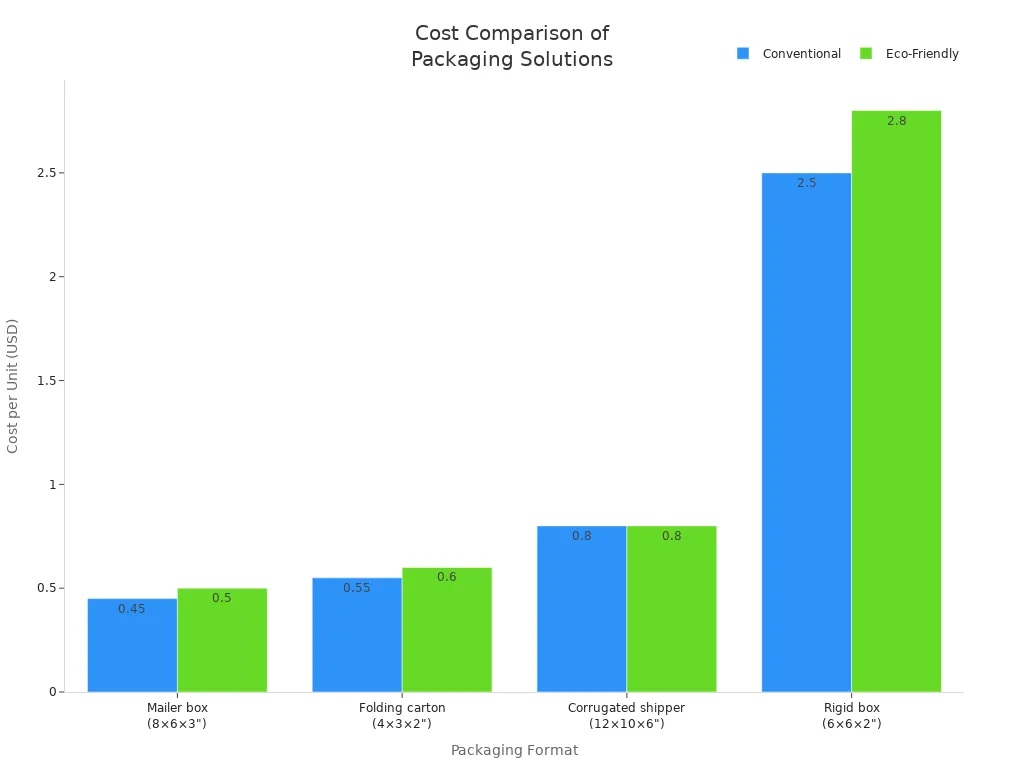
You face many choices when selecting sustainable packaging for your business. Cost often stands out as a major factor. Sustainable options sometimes cost more than conventional packaging, but the price gap is shrinking. For example, recycled corrugated packaging can match or even beat the price of virgin materials. FSC-certified kraft boxes usually cost about 10% more than standard kraft. The table below compares the costs of different packaging formats:
|
Format |
Conventional |
Eco-Friendly |
Premium |
|---|---|---|---|
|
Mailer box (8×6×3") |
$0.45/unit |
$0.50/unit |
+10% |
|
Folding carton (4×3×2") |
$0.55/unit |
$0.60/unit |
+10% |
|
Corrugated shipper (12×10×6") |
$0.80/unit |
$0.80/unit |
0% |
|
Rigid box (6×6×2") |
$2.50/unit |
$2.80/unit |
+12% |
You should also consider durability. Sustainable packaging must protect your products during shipping and storage. Many eco-friendly packaging solutions, such as recyclable gable boxes, offer strong protection and resist damage. These options help you avoid product loss and returns, which saves money in the long run.
Sustainability remains the core goal. You can choose packaging made from recycled, compostable, or biodegradable materials. These choices reduce your environmental impact and support your brand’s commitment to eco-friendly practices. When you balance cost, durability, and sustainability, you create a packaging strategy that benefits both your business and the planet.
Customization and branding potential
You can use sustainable packaging to strengthen your brand and connect with customers. Custom designs and creative finishes make your products stand out. High-quality materials increase the perceived value of your products. Sustainable packaging aligns with consumer values and builds trust.
- High-quality packaging materials make your products feel premium.
- Eco-friendly packaging shows your commitment to the environment and attracts loyal customers.
- The unboxing experience creates excitement and satisfaction, which boosts brand loyalty.
The unboxing experience is an opportunity to make a lasting impression on your customers. A well-designed package not only protects the product but also creates a moment of excitement and satisfaction.
You can use recyclable gable boxes with custom prints, hand-drawn illustrations, or natural textures. These features tell your brand’s story and highlight your sustainable values. Limited-edition boxes or seasonal designs create anticipation and encourage repeat purchases. Compostable packaging, such as kraft paper with compostable coatings, appeals to eco-conscious shoppers and reduces landfill waste.
Sustainable packaging also helps you position your brand as a leader in eco-friendly practices. You can invest in transparent labeling and make recycling easy for your customers. Many brands use packaging made from post-consumer recycled materials to show their dedication to reducing waste. This approach attracts shoppers who care about the environment and want to support responsible businesses.
Supply chain reliability and customer preferences
You need to ensure a reliable supply of sustainable packaging materials. Supply chain disruptions, such as material shortages or transportation delays, can affect the availability of eco-friendly packaging. These challenges may impact your ability to deliver products on time.
Supply chain disruptions also add to the market’s challenges. Issues such as material shortages, transportation delays, and geopolitical tensions can impact the availability of sustainable materials and packaging products.
You should work with trusted suppliers who offer consistent quality and delivery. Choose partners who share your commitment to sustainability. This approach helps you avoid delays and maintain high standards for your packaging.
Customer preferences play a key role in your packaging decisions. Recent studies show that recyclability ranks as the top priority for most consumers. Many people prefer recyclable gable boxes because they are easy to reuse or recycle. In fact, 82% of consumers are willing to pay more for sustainable packaging, and 90% of Gen-Z shoppers value eco-friendly packaging. Products with sustainability claims have seen higher growth rates than those without such claims.
- 82% of consumers across age groups are willing to pay more for sustainable packaging.
- 90% of Gen-Z consumers prefer eco-friendly packaging.
- 71% of shoppers have chosen a product based on its sustainability credentials.
- 80% of consumers want refillable packaging to reduce their environmental impact.
You can meet these expectations by offering packaging that is both sustainable and practical. Recyclable gable boxes, compostable mailers, and reusable containers appeal to a wide range of customers. By listening to your customers and adapting to their needs, you build loyalty and set your brand apart in a crowded market.
Innovative and surprising paper packaging options
You can discover many innovative paper packaging solutions that go beyond the basics. These sustainable options help your business stand out and support your environmental goals.
Seed-infused and plantable paper packaging
Seed-infused packaging transforms waste into new life. You can use these sustainable solutions to engage customers and promote eco-friendly habits. After use, customers plant the packaging, which grows into flowers or herbs. This approach supports biodiversity and reduces landfill waste.
|
Benefit |
Description |
|---|---|
|
Waste Reduction |
Supports initiatives to reduce waste and encourages eco-friendly practices among consumers. |
|
Biodiversity Promotion |
Enhances biodiversity by reducing plastic usage and supporting sustainable farming practices. |
|
Brand Image Enhancement |
Improves brand image and appeals to environmentally conscious consumers, fostering loyalty. |
|
Consumer Participation in Sustainability |
Increases consumer involvement in sustainability efforts, transforming packaging into activism. |
-
Seed paper is biodegradable and compostable, aligning with eco-friendly initiatives.
-
It supports pollinator-friendly plants and reduces reliance on synthetic materials.
-
The market for seed paper bags is growing as more people seek compostable and sustainable packaging solutions.
Molded pulp and 3D forms
Molded pulp packaging offers strong protection for fragile items. You can find these sustainable solutions in many industries, such as food, healthcare, electronics, and cosmetics.
|
Characteristic |
Molded Pulp Packaging |
Traditional Paper Packaging |
|---|---|---|
|
Shock Absorption |
Excellent for electronics and fragile items. |
Less effective in shock absorption. |
|
Strength |
High strength and durability. |
Often less robust for heavy items. |
|
Versatility |
Customizable for many applications. |
Limited customization. |
|
Sustainability |
Biodegradable and made from recycled materials. |
Less sustainable in some cases. |
|
Cost |
Potentially higher production costs. |
Often lower production costs. |
You can use molded pulp for compostable takeout boxes, which offer both durability and compostability.
Water-resistant and barrier-coated papers
Water-resistant and barrier-coated papers provide extra protection for food and liquids. These sustainable paper packaging solutions use eco-friendly coatings instead of plastic. You can choose compostable takeout boxes with water-resistant linings to keep food fresh and reduce waste. These solutions support compostability and help you meet strict food safety standards.
Reusable and multi-use paper packaging
Reusable packaging eliminates waste at the source. You can encourage customers to reuse paper-based packaging, which supports a circular economy. These sustainable solutions reduce the volume of waste sent to landfills and lower your carbon footprint. Businesses that use reusable and compostable takeout boxes often see reduced shipping costs and improved customer retention.
Custom designs and eco-friendly finishes
Custom designs help you reach your sustainability goals. You can use eco-friendly finishes like aqueous or UV coatings, soft touch, and embossing to create unique packaging. These sustainable solutions reduce your carbon footprint and attract customers who value compostable and recyclable options. Custom designs also educate consumers about compostability and encourage them to reuse or recycle packaging.
Tip: Visually appealing and sustainable packaging can increase customer engagement and boost your brand’s reputation.
How to evaluate and implement sustainable paper packaging
Questions for suppliers about eco-friendly options
You need to ask the right questions when choosing eco-friendly packaging suppliers. Start by requesting proof of certifications. Certifications ensure compliance with standards that protect the environment and consumers. Suppliers who align their certifications with your company goals help you gain a competitive edge. Green certification also enhances your brand reputation. You should ask about the materials used. Prioritize renewable or recycled resources instead of virgin materials. Check if suppliers follow ethical labor practices and fair trade standards. Ask if they source locally or use low-impact methods to reduce transportation emissions. These steps support eco-friendly practices and help you implement sustainable packaging.
- What certifications do you hold for sustainable packaging?
- Do you use renewable or recycled materials?
- How do you ensure ethical labor and fair trade?
- Can you source locally to reduce environmental impact?
Testing performance and environmental impact
You must test packaging for product protection and environmental impact. Run trials to see how packaging performs during shipping and storage. Check durability, moisture resistance, and strength. Evaluate if the packaging can recycle or compost easily. Testing helps you confirm that sustainable packaging meets your needs and reduces waste. Use feedback from customers to improve packaging design and functionality. Testing ensures you deliver quality while supporting eco-friendly goals.
Tip: Always test packaging in real-world conditions before full-scale adoption.
Lifecycle analysis and customer insights
Lifecycle analysis gives you a complete view of environmental impact. It evaluates packaging from sourcing to end-of-life. This process helps you align decisions with sustainable goals. You learn how packaging affects the environment at each stage. Understanding consumer perception is crucial. Gather customer insights to see how people respond to sustainable packaging. Use surveys and reviews to measure satisfaction and identify areas for improvement. Lifecycle analysis and customer feedback guide you in implementing sustainable packaging that meets both environmental and business objectives.
Common mistakes to avoid
Overlooking environmental costs
You might focus on the look and feel of packaging, but miss hidden environmental costs. Many businesses choose attractive packaging with glossy finishes or plastic coatings. These materials often cannot be recycled, which increases waste and adds to landfill burden. Over-packaging wastes natural resources and leads to unnecessary carbon emissions. You should also consider regional recycling capabilities. Some areas cannot process certain materials, so improper disposal becomes a problem. Fragile packaging can cause damaged goods, which increases waste and creates a larger impact from returns. Businesses that ignore these factors risk harming the environment and losing customer trust.
Note: Over-packaging not only increases waste but also raises your carbon footprint. You can reduce impact by selecting recyclable and compostable options.
Ignoring customer feedback
Many businesses overlook the importance of customer feedback when choosing packaging. Customers value convenience and sustainability. If packaging is difficult to open or dispose of, you may see negative reviews and lower satisfaction. User experience matters. Inconvenient packaging can lead to waste and dissatisfaction. Businesses that listen to customers gain valuable insights and improve their impact. You can use surveys and reviews to understand preferences and adjust your packaging strategy. Ignoring feedback can result in lost sales and missed opportunities for improvement.
|
Mistake |
Result |
|---|---|
|
Ignoring feedback |
Lower satisfaction, more waste |
|
Listening to customers |
Higher loyalty, less impact |
Failing to test in real-world scenarios
You need to test packaging in real-world conditions. Many businesses skip this step and face unexpected problems. Packaging that performs well in theory may fail during shipping or storage. Testing helps you identify weaknesses and reduce waste. You can check durability, moisture resistance, and overall impact. Businesses that test packaging avoid costly returns and improve product protection. Real-world testing ensures your packaging meets both environmental and business goals.
Tip: Always test packaging before full-scale adoption. This step reduces waste and protects your reputation.
You can make a real difference by choosing sustainable paper packaging solutions. Start by reviewing your current packaging, then look for certified, recyclable, or compostable options. Explore innovative materials like seed-infused paper or molded pulp. These choices help protect the environment and set your brand apart. Take action today—evaluate your packaging and try new eco-friendly solutions. Your customers and the planet will thank you.
FAQ
What makes paper packaging sustainable?
You choose sustainable paper packaging when you use recycled, compostable, or responsibly sourced materials. These options reduce waste and support environmental goals. Look for certifications like FSC or PEFC to confirm sustainability.
Can you recycle all types of paper packaging?
Not all paper packaging is recyclable. Coatings, laminates, or food contamination can prevent recycling. Always check local recycling guidelines and choose packaging labeled as recyclable.
How does compostable paper packaging work?
Compostable paper packaging breaks down into natural elements in composting conditions. You can add it to your home or industrial compost bin. It returns nutrients to the soil without leaving harmful residues.
Does eco-friendly packaging cost more?
Eco-friendly packaging sometimes costs more than traditional options. However, you may save money by reducing waste and improving brand loyalty. Many customers will pay extra for sustainable choices.

 +1 626 369 5099


 IPv6 network supported